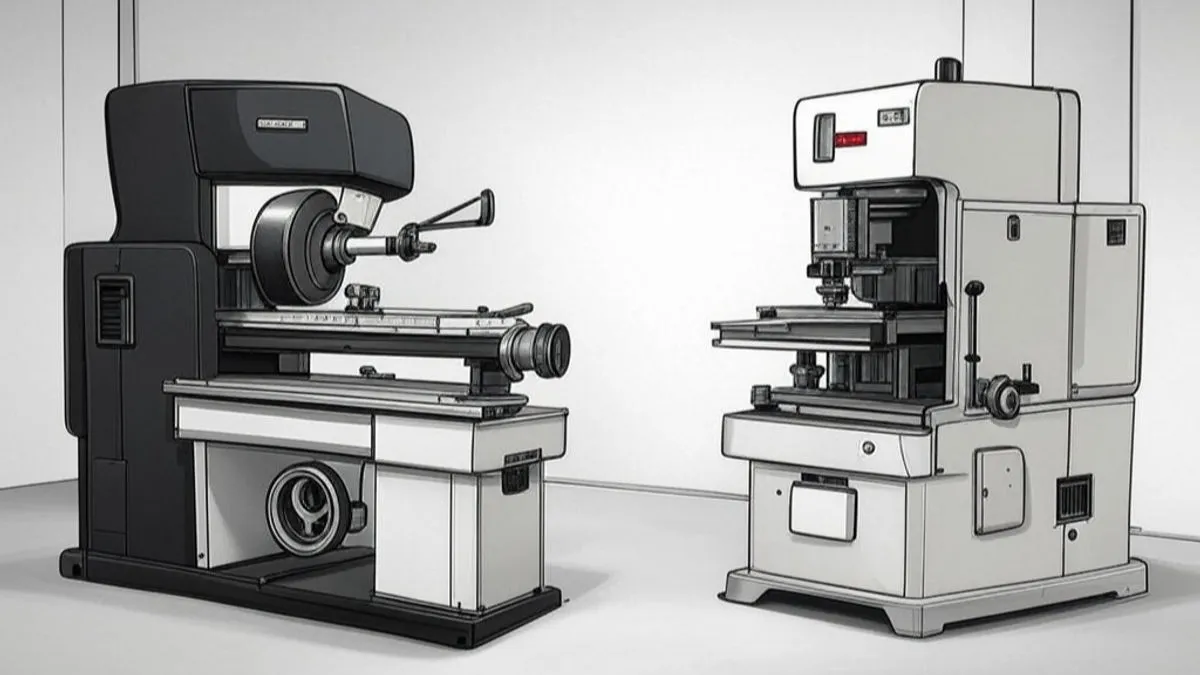
The Two Fundamental CNC Machining Processes
CNC turning and CNC milling are the two most important cutting manufacturing processes. Together, they cover over 90% of all machining tasks. But which process is suitable for which component? And when is a combination worthwhile?
CNC Turning: How It Works
The Principle
In CNC turning, the workpiece rotates in the spindle while a fixed tool creates the desired contour. The rotation of the workpiece determines the cutting speed.
Typical Components
- Shafts and axles: Rotationally symmetrical with shoulders, grooves and threads
- Bushings and sleeves: Internal and external machining
- Flanges and adapters: Circular base geometry with bores
- Bolts and pins: Simple rotationally symmetrical shapes
Strengths of Turning
Turning is the most economical process for rotationally symmetrical parts: shorter machining times than milling, better surface quality on cylindrical surfaces and more efficient material use in bar machining.
CNC Milling: How It Works
The Principle
In CNC milling, the tool (milling cutter) rotates while the workpiece is fixed on the machine table. The tool moves in up to 5 axes simultaneously around the workpiece.
Typical Components
- Housings and frames: Prismatic base shape with pockets and hole patterns
- Plates and covers: Flat components with contours and steps
- Moulds and tools: Complex 3D freeform surfaces
- Brackets and consoles: Irregular geometries
Strengths of Milling
Milling offers maximum geometric freedom: pockets, slots, contours, freeform surfaces and complex 3D geometries are possible. With 5-axis simultaneous machining, virtually any shape can be created.
Decision Guide: Turning or Milling?
Choose Turning When...
- The basic shape is rotationally symmetrical (round)
- External and internal threads are needed
- High volumes of cylindrical parts are being produced
- Tight runout tolerances are required
Choose Milling When...
- The basic shape is prismatic (angular)
- Pockets, slots or contours are needed
- Complex 3D freeform surfaces are required
- Irregular geometries need to be machined
The Combination: Mill-Turn Centres
Modern mill-turn centres combine both processes in a single machine. The workpiece can be simultaneously turned and milled, ideal for components that have both rotationally symmetrical and prismatic features.
Advantages of complete machining: higher accuracy (no re-clamping), shorter throughput times and lower costs by eliminating the second setup.
Cost Factors Compared
Fundamentally, turning is more cost-effective for suitable components, as the machines are simpler and allow higher feed rates. Milling becomes more economical with increasing complexity, particularly with 5-axis machining. More on cost factors in our detailed cost comparison.
Frequently Asked Questions (FAQ)
Can you also mill on a lathe?
Yes, modern CNC lathes with driven tools can perform cross bores, flats and simple milling operations. For complex milling work, a dedicated machining centre is more efficient.
Which process delivers better surfaces?
In turning, roughness values down to Ra 0.4 µm are achievable on cylindrical surfaces. In milling, the surface depends heavily on the strategy, with ball nose cutters, similar values are possible but with more effort.
Is 5-axis milling always better than 3-axis?
No, for many components, 3-axis machining is perfectly sufficient and more cost-effective. 5-axis is worthwhile for undercuts, angled surfaces or when the number of setups needs to be reduced.
Conclusion: The Component Determines the Process
The choice between CNC turning and CNC milling is primarily determined by the component geometry. An experienced manufacturing partner selects the optimal process, or the right combination, for your component.
Unsure which process is right? Send us your drawing, we'll recommend the most economical manufacturing process.