Why Tool Material Is Critical for Machining Quality
In CNC machining, the tool is the direct interface between machine and workpiece. Material and coating of the tool largely determine the achievable surface quality, dimensional accuracy and economics of the entire manufacturing process.
The wrong tool means not just poorer results, it can increase the unit price by 30-50% and drastically increase scrap risk.
Tool Materials Overview
HSS (High-Speed Steel)
HSS is the oldest tool material and is mainly used today for drills, taps and reamers. Advantages: high toughness, easy re-grinding. Disadvantage: low hot hardness, therefore limited cutting speeds (vc max. approx. 40-60 m/min for steel).
Carbide (Solid Carbide)
Carbide is the current standard for CNC milling cutters and turning tools. It consists of tungsten carbide (WC) in a cobalt matrix (Co). The composition determines the properties:
- Fine grain (0.5-0.8 µm): Highest hardness and wear resistance, ideal for finishing
- Medium grain (1-2 µm): Balanced ratio, standard applications
- Coarse grain (2-5 µm): Maximum toughness, interrupted cuts, roughing
Ceramic and Cermet
Ceramic cutting materials (Al2O3, Si3N4) achieve extremely high cutting speeds (up to 1,000 m/min for cast iron) but are very brittle. Cermets (TiC/TiN-based) offer a good balance for finishing of steel.
PCD (Polycrystalline Diamond) and CBN
PCD is the hardest tool material and is used for abrasive materials such as aluminium-silicon alloys, CFRP and graphite. CBN (cubic boron nitride) is the choice for hardened steels (>55 HRC).
Coatings: The Invisible High-Tech Layer
Why Coat?
Modern coatings are only 2-5 µm thin but have an enormous impact:
- 2-3x longer tool life through wear protection
- 30-50% higher cutting speeds through thermal insulation
- Better surfaces through reduced friction
- Less built-up edge formation with adhesive materials
The Most Important Coating Types
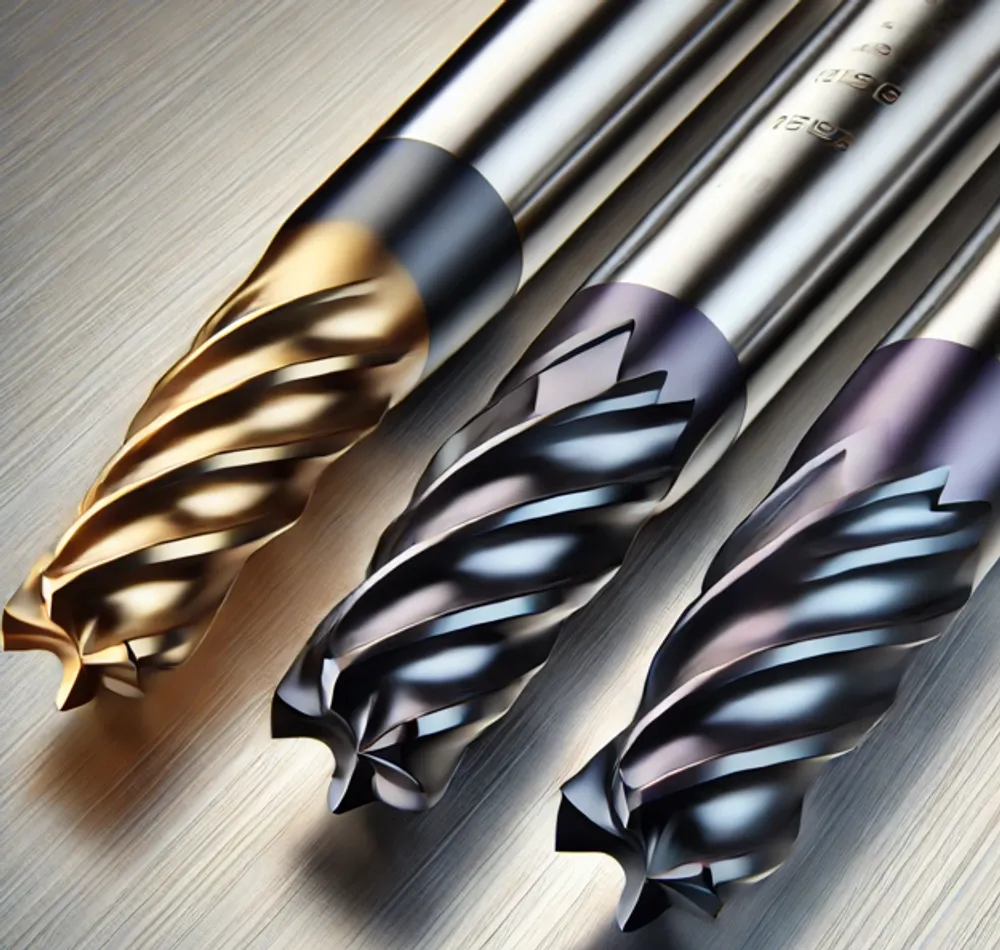
- TiN (Titanium nitride): Gold-coloured, universally applicable, good entry-level
- TiAlN (Titanium aluminium nitride): Purple-grey, highest hot hardness, standard for steel and stainless steel
- AlCrN (Aluminium chromium nitride): For extreme temperatures, ideal for dry machining
- DLC (Diamond-Like Carbon): Extremely smooth, perfect for aluminium, prevents built-up edge
- Uncoated + polished: For aluminium, often the best choice, maximum sharpness, minimum friction
Practical Recommendations by Material
Aluminium
Uncoated, polished solid carbide tools or DLC coating. High cutting speeds (300-1,000 m/min). Important: sharp cutting edges and large chip flutes for good chip evacuation.
Carbon Steel and Alloy Steel
TiAlN-coated solid carbide tools. Moderate cutting speeds (150-250 m/min). The coating protects against high thermal wear.
Stainless Steel (1.4301, 1.4404)
AlCrN or TiAlN coating with high Al content. Lower cutting speeds (80-150 m/min) but higher feed rates. Good coolant supply is critical.
Frequently Asked Questions (FAQ)
Is a more expensive coating worthwhile?
Almost always yes. A TiAlN coating costs only €5-10 more per tool but can double tool life and enable higher cutting speeds, significantly reducing unit costs.
Can tools be re-coated?
Yes, re-ground tools can be professionally re-coated. This costs approx. 30-50% of a new tool and achieves nearly the same tool life.
When is PCD economically viable?
For high quantities in aluminium, CFRP or other abrasive materials. A PCD tool costs 5-10 times as much as a solid carbide tool but lasts 10-50x longer.
Conclusion: The Right Tool Saves More Than It Costs
Investing in the right tool material and the appropriate coating almost always pays for itself, through longer tool life, better surfaces and more efficient machining.
Questions about tool selection? Contact us, we are happy to advise you on the optimal tool strategy for your component.