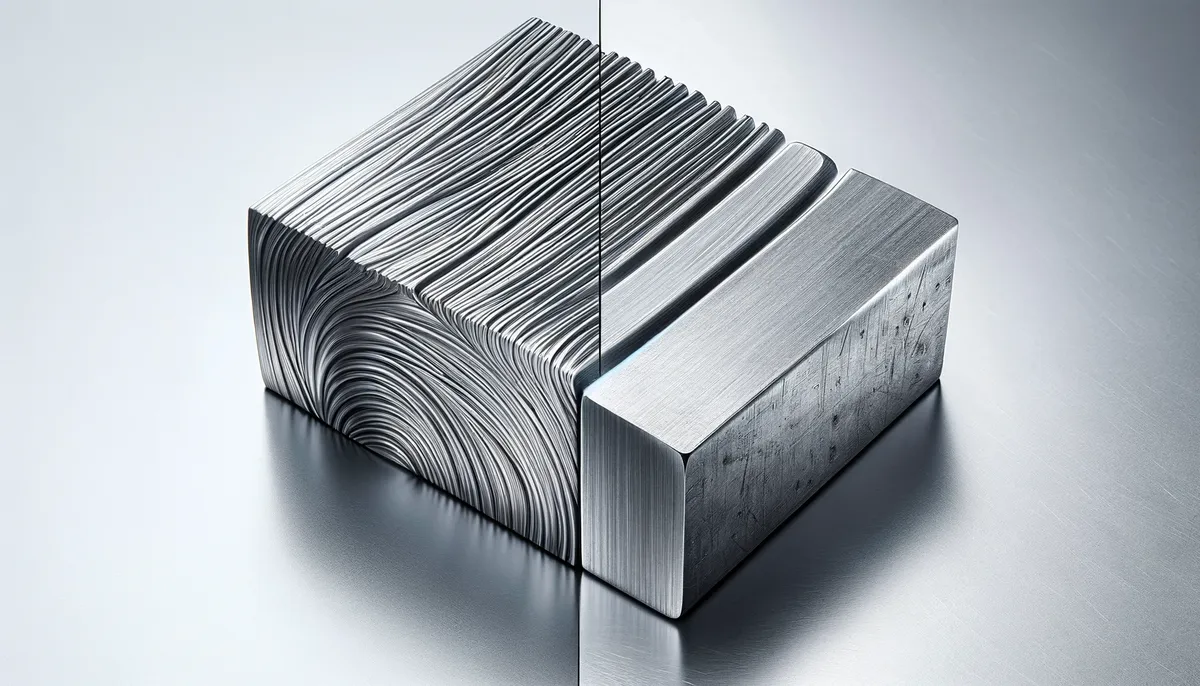
Why the Choice of Bar Stock Matters
When ordering raw material for CNC manufacturing, you often face the choice: drawn or extruded bar stock? This seemingly unimportant decision can have significant effects on dimensional accuracy, machining behaviour and costs of your component.
Extruded (Hot-Formed) Bar Stock
The Process
In extrusion, a heated billet is pressed through a die. The result: bars with the desired cross-section. The process is cost-effective and enables large cross-sections.
Properties
- Surface quality: Rough, with mill scale (steel) or oxidised (aluminium)
- Dimensional accuracy: Tolerances typically ±0.5-1.5 mm
- Internal stresses: Relatively high, can cause distortion during machining
- Price: Cheapest option
Drawn (Cold-Formed) Bar Stock
The Process
After hot forming, drawn bar stock undergoes cold drawing through a die. This cold forming improves dimensional accuracy and surface quality considerably.
Properties
- Surface quality: Smooth, bright surface (silver-grey)
- Dimensional accuracy: Tolerances typically h9 to h11 (±0.02-0.1 mm)
- Internal stresses: Present but more uniform
- Strength: Higher than hot-formed due to work hardening
- Price: Approx. 20-40% more expensive than extruded
Precision-Ground (Centreless Ground) Material
The premium option: after cold drawing, the material is additionally ground to h6 tolerances (typically ±0.005-0.010 mm). For precision turned parts where the outer diameter is used directly. Approx. 50-80% more expensive than extruded.
Impact on CNC Machining
Setup and Zero-Point Setting
Drawn bar stock with tighter tolerances allows more reliable clamping in the chuck, less adjustment, faster setup. Extruded material with varying diameters can cause problems with automatic bar feeders.
Machining Allowance
Extruded material needs more oversize to compensate for dimensional and shape deviations. This means more machining and therefore longer cycle times and higher tool wear.
Residual Stress
Both bar types contain residual stresses. During asymmetric material removal, these can cause distortion of the workpiece. Stress-relief annealing before machining is recommended for precision parts.
Frequently Asked Questions (FAQ)
Which bar stock for CNC automatic lathe machining?
For bar-fed CNC lathes, drawn (h9 or better) bar stock is the standard. The tighter tolerances ensure reliable operation of the bar feeder.
Can I always save money with extruded material?
No, the lower material price can be offset by higher machining time and more scrap. For precision parts, drawn or ground material is often overall more economical.
Conclusion: The Right Starting Material Saves Time and Money
Choosing the right bar stock is an often overlooked cost lever. Think about what your component really needs, and optimise from there.
Advice on material selection needed? Contact us, we help you find the optimal starting material.